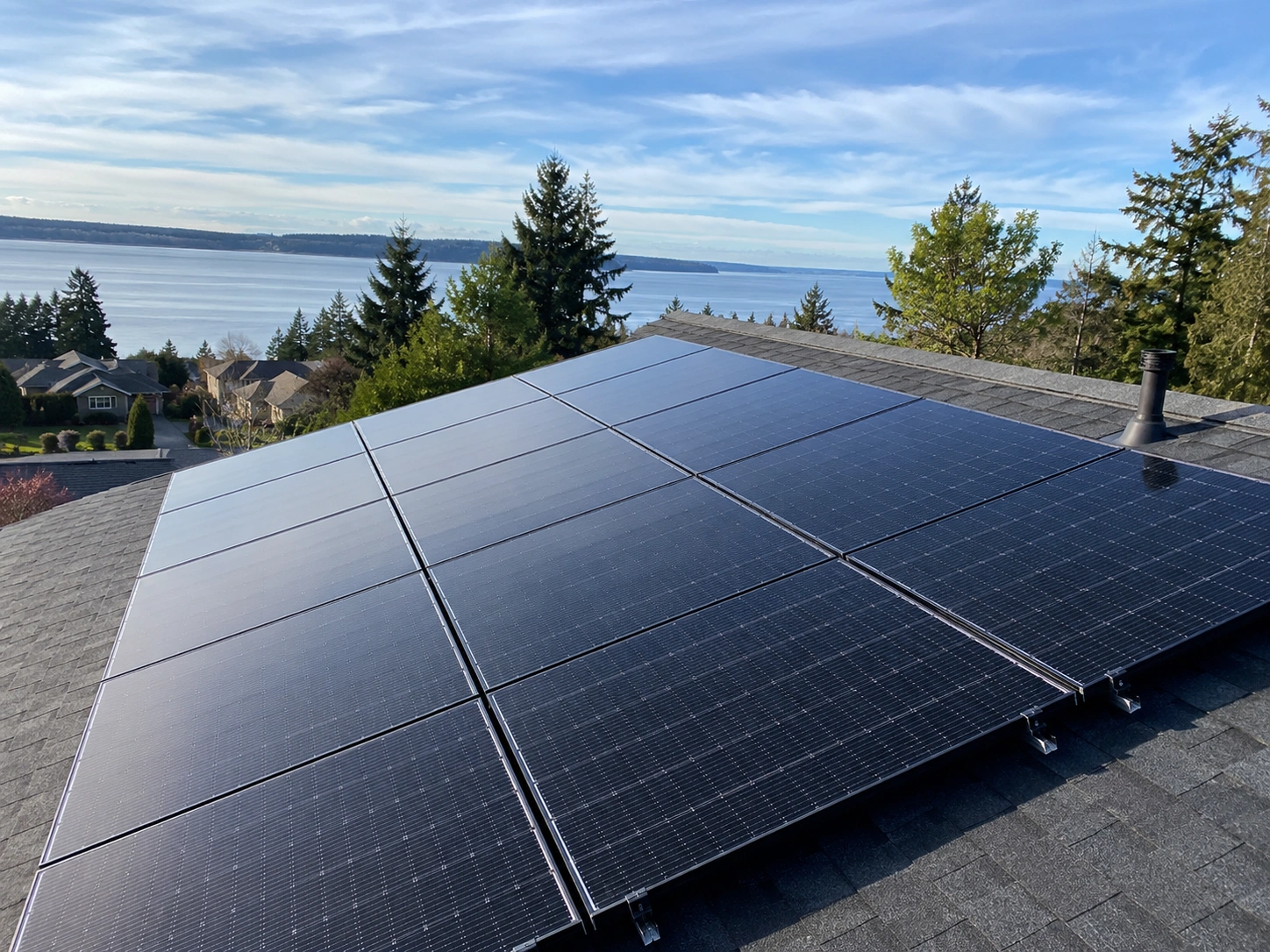
At A Clean Streak, the customer always comes first. We take pride in offering the highest quality products and service in the industry.
You spent thousands on a solar panel system. It should be earning back every dollar. But panels lose output when pollen, bird droppings, tree sap, and salt film sit on the glass for months. Rain washes off loose dust. It does nothing for the sticky buildup, and that buildup is what drives most of the output loss.
A Clean Streak is the solar panel cleaning service homeowners across Oak Harbor and Island County trust to get the job done right. We use deionized water at low pressure with soft tools only, keeping your panel coatings and warranty intact. We have been doing this on Whidbey since 2014, and our 241+ Google reviews sit at a 4.8-star average. There is a reason we won Best of Whidbey two years running.
If your system output has been slipping, give us a call at 360-395-5748 or request a free quote.
Solar researchers have been measuring soiling losses for years. These are national figures, not specific to western Washington. But they paint a useful picture.
A UC San Diego study of 185+ systems in California found soiling reduced output by about 7.4% in dry conditions. Rainy areas do better for general dust. Where things get interesting is pollen. A 2023 NREL study of five utility-scale plants in North Carolina found output dropped by up to 15% during peak pollen season. And this was in a state with plenty of rain.
Those same plants had gone about seven years without a professional cleaning. After one wash, output jumped back 5% to 11%. NREL’s Performance Parameters research suggests 5% as a typical soiling loss for planning purposes.
That same 2023 study confirmed rain alone does not remove pollen. In fact, pollen bonds to the glass and water runs right over it.
On Whidbey Island, dust losses are modest. Rain handles the light film. Pollen and biological buildup are what catch people off guard.
A single bird dropping does not just block one cell. In a string-inverter system, the weakest panel drags down every other panel on that string. Three panels under a Douglas fir can throttle output for a whole section of your array.
Your actual loss depends on your setup. Panels in open sky with nothing overhead might lose 2% of output. Panels under heavy tree cover with birds roosting on the ridge? That can climb to 10%. On a 7 kW system, the gap between 2% and 10% is over $100 a year in lost electricity.
How to Check Your Own Panels
Open your monitoring app or inverter dashboard. Look at the trend over the past few months. A gradual decline through summer usually points to soiling.
A sudden drop is different. Output falls off a cliff overnight? Probably electrical. An inverter failure, a wiring issue, a tripped breaker. Call an electrician before you call a cleaner.
Take a 7 kW system in the Oak Harbor area. It produces roughly 7,500 kWh per year. At Puget Sound Energy’s blended rate of about 19 cents per kilowatt-hour, that is around $1,425 annually.
Soiling loss
kWh lost per year
Annual cost (PSE, Whidbey)
Annual cost (SnoPUD, Camano)
2%
150 kWh
~$29
~$16
5%
375 kWh
~$71
~$40
10%
750 kWh
~$143
~$80
A 2% loss sounds like nothing. And honestly, in a rainy year with no trees overhead, it probably is. But at 5% you are losing $71 a year on Whidbey. Every year. At 10%, that is $143 gone on a conservative system size.
Camano Island homeowners on SnoPUD pay less per kWh, but the output loss is the same.
Why Choose Us?
LOCAL BUSINESS
FAMILY OWNED
TRUSTED & Reliable
Our Residential Solar Panel Cleaning Process
Every job follows the same steps.
Roof and array access check. We look at the pitch, the footing, and how to reach every panel safely.
Loose debris removal. Leaves, needles, and anything sitting on the surface gets cleared by hand first.
Spot treatment. Bird droppings, tree sap, and moss get worked with soft brushes. There’s no scraping or use of abrasives.
Deionized water rinse. We rinse every panel with purified water. Deionized water leaves zero mineral spots on the glass.
Final check. Visual inspection of every panel once they dry.
Output reading. If your monitoring system is accessible, we note the before and after numbers so you can see the difference.
Low pressure protects the glass and the anti-reflective coating that most modern panels have. We never spray cold water onto panels baking in the sun. Thermal shock cracks glass. We time the job to avoid it.
How Often Should Solar Panels Be Cleaned in Island County
Most homeowners need their panels cleaned once a year. Some need it twice. It depends on your property.
Your situation
How often
Best timing
Open sky, no overhanging trees
Once a year
Late May through June, after pollen season wraps up
Heavy tree cover or near the shoreline
Twice a year
Late May + early October
Visible droppings, sap, or moss on panels
As soon as you notice
Do not wait for the next scheduled visit
Nearby construction or farm activity
Check your monitoring app
Clean if output has dropped
Late spring works best because pollen has finished falling and the dry summer has not yet baked everything onto the glass. A fall visit catches what summer leaves behind, before the wet season pins debris in place.
Solar Panel Cleaning Across Island County
Not every part of Island County gets the same weather. Those differences show up in your panels.
Oak Harbor and the northern end of Whidbey sit in the Olympic rain shadow. The area gets roughly 20 inches of rain per year, less than most of western Washington. Less rain means less natural rinsing. Panels here hold onto pollen and dust longer than homeowners expect.
South Whidbey is a different story. Langley, Clinton, and Freeland see rainfall in the low 30s, which helps with dust. The tradeoff is tree cover. Homes near Greenbank and through the South Whidbey woods deal with sap, needles, and moss shade on panels from the Douglas firs and cedars overhead.
Shoreline properties in Coupeville and Clinton pick up salt film from the marine air. Barely visible, but it builds over weeks and cuts light transmission.
Camano Island sits across Saratoga Passage and runs its own utility (Snohomish County PUD, at about 10.6 cents per kWh). Tree cover varies by neighborhood, but salt air is a factor along the western shore.
What Affects the Cost of Solar Panel Cleaning
The price depends on your setup.
Number of panels. A 12-panel residential system takes less time than a 36-panel one.
Roof pitch and access. Steep roofs need more safety setup. Ground-mounted arrays are easier to reach.
Level of buildup. Light dust is quicker to clean than heavy biological growth.
Bundling. When we are already on the roof for panel cleaning, adding roof washing or gutter cleaning saves a second trip.
Protect Your Solar Investment and Your Roof
The crew is already up there. Cleaning your panels pairs well with a roof wash, a gutter cleanout, or both. Moss growing near your panels is probably growing on your roof too, and the same visit handles both surfaces.
Why Choose A Clean Streak for Solar Panel Cleaning
A Clean Streak is a locally owned solar panel cleaning company based right here on Whidbey Island.
We have cleaned panels on flat roofs, steep pitches, and ground-mounted arrays across every town in Island County. Every job comes with our 100% satisfaction guarantee.
We live and work here. When you call, you get the crew that already knows these roofs.
Frequently Asked Questions About Solar Panel Cleaning
Once a year for most homes. If your panels sit under trees or near the shoreline, twice a year keeps output where it should be. The frequency table above has the full breakdown.
Rain handles loose dust, yes. It does not remove pollen, bird droppings, tree sap, or salt film. NREL confirmed in a 2023 study that pollen bonds to glass and rain runs over it without breaking it free.
Check your monitoring app. A gradual output decline over weeks or months usually means soiling. If the drop was sudden, that is likely an electrical issue and not dirty glass. Get an electrician to look at it first.
Climbing onto a roof carries real risk, and using the wrong tools or water pressure can scratch the anti-reflective coating or crack the glass. We recommend leaving it to a crew with the right equipment and training.
We cover all of Island County. Oak Harbor and Coupeville. Freeland and Langley. Clinton and Camano Island. See the full list of areas below or call us at 360-395-5748.